分析
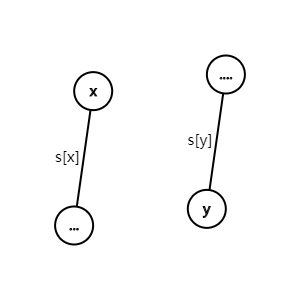
假设有如下图两个集合 $x$ & $y$。因为要构造一个完全图,所以应该将$x$中的$s[x]$个节点与$y$中的$s[y]$个节点一一连接即连接$s[x] * s[y] - 1$(此处减一是为了在后面单独处理原图中的$dis[i].w$)个节点,为了保证此完全图的最小生成树所以要用$(s[x] * s[y] - 1) * (dis[i].w + 1)$,最后加上原图中的$dis[i].w$。
代码
1
2
3
4
5
6
7
8
9
10
11
12
13
14
15
16
17
18
19
20
21
22
23
24
25
26
27
28
29
30
31
32
33
34
35
36
37
38
39
40
41
42
43
44
45
46
47
48
49
50
51
52
53
54
55
56
57
58
59
60
| #include <cstdio>
#include <iostream>
#include <algorithm>
#define LL long long
using namespace std;
const int MAXN = 1e5 + 5;
int n, fa[MAXN], s[MAXN];
LL ans;
struct node {
int u, v, w;
} dis[MAXN];
bool cmp (node x, node y) {
return x.w < y.w;
}
int FindSet(int v) {
if (fa[v] == v) {
return v;
} else {
return fa[v] = FindSet(fa[v]);
}
}
bool UnionSet(int v, int u) {
int x = FindSet(v);
int y = FindSet(y);
if (x == y) return 0;
else {
fa[x] = fa[y];
return 1;
}
}
void Kruskal() {
sort (dis + 1, dis + n, cmp);
for (int i = 1; i <= n; i++) {
s[i] = 1;
fa[i] = i;
}
for (int i = 1; i < n; i++) {
int x = FindSet(dis[i].u);
int y = FindSet(dis[i].v);
if (x == y) continue;
ans += (long long)(dis[i].w + 1) * (s[x] * s[y] - 1) + dis[i].w;
fa[x] = y;
s[y] += s[x];
}
printf("%lld\n", ans);
}
int main() {
scanf ("%d", &n);
for (int i = 1; i < n; i++) {
scanf ("%d %d %d", &dis[i].u, &dis[i].v, &dis[i].w);
}
Kruskal();
return 0;
}
|